
On June 5, 2017, a convoy of vans and SUVs drove west from El Paso, Texas, and crossed into New Mexico, headed to a location about 20 miles southwest of Las Cruces. Leaving the pavement behind, we bumped along single-file on dirt roads, marking our way with a trail of GPS “breadcrumbs” and stopping occasionally to let the lagging vehicles catch up. Our destination: a geologist’s wonderland called the Potrillo volcanic field.
New Mexico is home to an impressive number and variety of volcanoes, spread over the state from top to bottom. Among them is the Potrillo volcanic field, a now-dormant region in the New Mexico portion of the Chihuahuan Desert. My team spent 10 days in June 2017 at Potrillo, visiting ancient craters and gently sloping shield volcanoes.
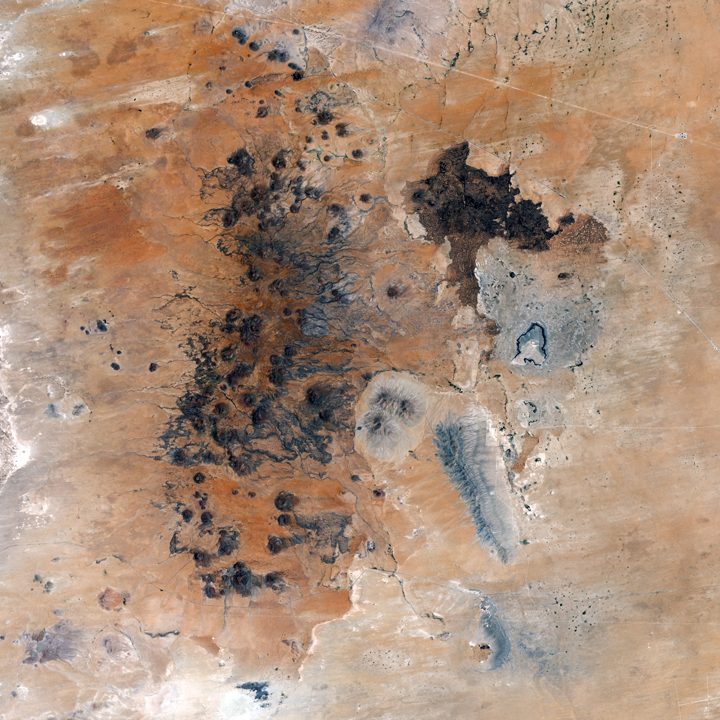
The Potrillo volcanic field. The volcanoes here are monogenetic, which means that when they were active, each one probably had a single eruption. These days, the Potrillo volcanoes are dormant. NASA Earth Observatory image by Jesse Allen.
Our team chose Potrillo because it combines the maar craters formed by explosive volcanism with the shield volcanoes formed by effusive volcanism. This makes it a perfect analog site for testing the kinds of instruments that future explorers might use to investigate volcanic areas on the Moon, Mars and other rocky planets or moons. We brought an array of instruments to map the topography of this terrain and to investigate the mineral composition and chemistry of the volcanic features here.
One of our destinations in the Potrillo volcanic field was the crater called Kilbourne Hole, shown in this fly-over footage taken by our unmanned aerial vehicle. Music in this short video was provided by Killer Tracks. NASA/GSFC/UTEP.
I’m Jake Bleacher from NASA’s Goddard Space Flight Center in Greenbelt, Maryland, and I led this trip. The group included planetary geologists from NASA Goddard; Stony Brook University in Stony Brook, New York; the University of Texas, El Paso; Johnson Space Center in Houston; and other institutions. This team is part of RIS4E, short for Remote, In Situ, and Synchrotron Studies for Science and Exploration, a five-year project led by Timothy Glotch of Stony Brook University. RIS4E is funded by NASA’s Solar System Exploration Research Virtual Institute, or SSERVI, which promotes collaboration linking science to human exploration.
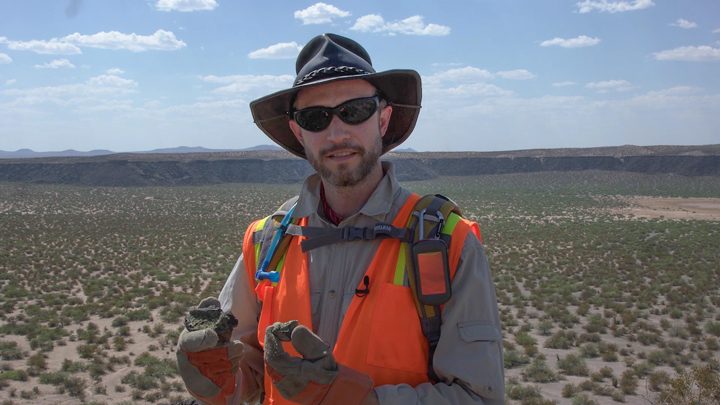
Here, I’m pictured in the black leather cowboy hat I’ve worn on all field excursions for more than 15 years. NASA/GSFC
The Goddard Instrument Field Team, as a part of the RIS4E Project, explores Kilbourne Hole, a maar crater in the Potrillo volcanic field in New Mexico.NASA/GSFC
Helping me document the trip for NASA were Elizabeth Zubritsky, who worked with me on these blog entries, and two members of Goddard’s video team, David Ladd (producer) and Rob Andreoli (videographer).
The Goddard Instrument Field Team (GIFT) is a group of scientists and engineers at NASA’s Goddard Space Flight Center as well as their external collaborators. The team focuses on conducting field research campaigns in geologic settings that are analogous to locations on other planets and moons throughout the Solar System. We call these sites “planetary analogs,” and they help us learn how to interpret data from across the Solar System while focusing on understanding Earth better.
Just as we send spacecraft to explore other planets, we have a fleet of Earth-observing spacecraft that provide comparable data about our own world. Every space mission, whether Earth-focused or planetary-focused, provides data that helps us understand the local environment and the history or events that shaped the landscape. Often, though, it seems that for every answer we gain, we develop more new questions.
One way to answer these questions is to develop new instruments. At GIFT, we conduct field studies on Earth to help better inform the development of new instruments that could fly to other planets or could probe our home planet. Earth is but one of a series of planets that formed together in our Solar System, and there are many lessons to be learned about our celestial neighbors by studying our world. We also can learn more about our environment here at home by looking to other planets. GIFT carries out field deployments to a variety of locations to study the local geology and environment and looks at how those rocks might reveal knowledge about past environments. We use the lessons learned during those deployments to help develop new instruments and to improve instruments that will someday explore other parts of the Solar System to try and answer similar questions.