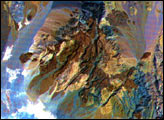

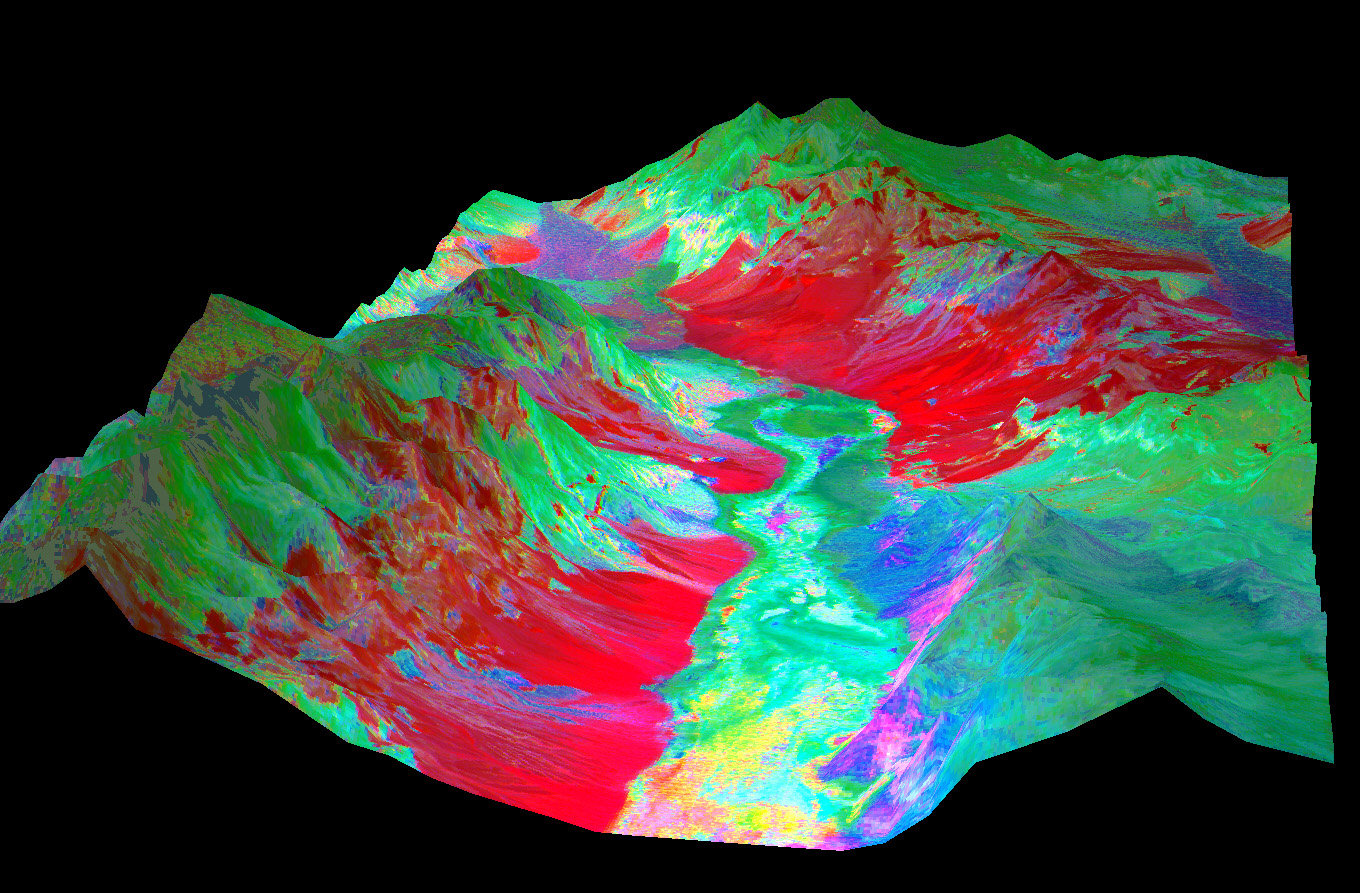
Since different materials reflect and emit energy in different ways, the Advanced Spaceborne Thermal Emission and Reflection Radiometer (ASTER), with its multi-spectral infrared channels, can provide detailed information about the composition of Earth’s surface. In this 3-D perspective view looking north over Death Valley, California, ASTER’s bands 13 (10.6µm), 12 (9.1µm), and 10 (8.3µm) are displayed in red, green and blue respectively. The data have been computer enhanced to exaggerate the color variations that highlight differences in types of surface materials.
Salt deposits on the floor of Death Valley appear in shades of yellow, green, purple, and pink, indicating the presence of carbonate, sulfate, and chloride minerals. The Panamint Mountains to the west and the Black Mountains to the east are made up of sedimentary limestones, sandstones, shales and metamorphic rocks. The bright red areas are dominated by the mineral quartz, found in sandstones; green areas are limestones. In the lower center of the image is Badwater, the lowest point in North America.
This image was produced by draping ASTER nighttime thermal infrared data, acquired on April 7, 2000, over topographic data from the U.S. Geological Survey.
Image courtesy NASA/GSFC/MITI/ERSDAC/JAROS, and U.S./Japan ASTER Science Team