
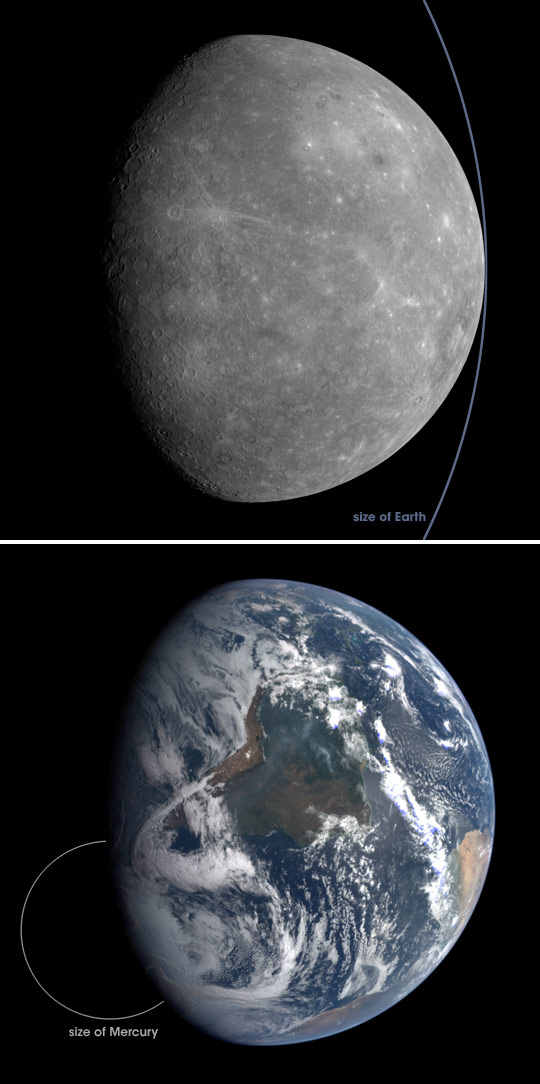
On January 14, 2008, NASA’s MESSENGER spacecraft performed its first flyby of the solar system’s innermost planet. The spacecraft captured images of parts of Mercury’s surface that planetary scientists had never seen, which will allow them to understand more about the planet’s formation and geologic history. Mercury has the oldest surface of all the planets, and its history is written on its face: enormous impact craters, smooth plains that may be lava fields, and long escarpments that may reveal fault lines.
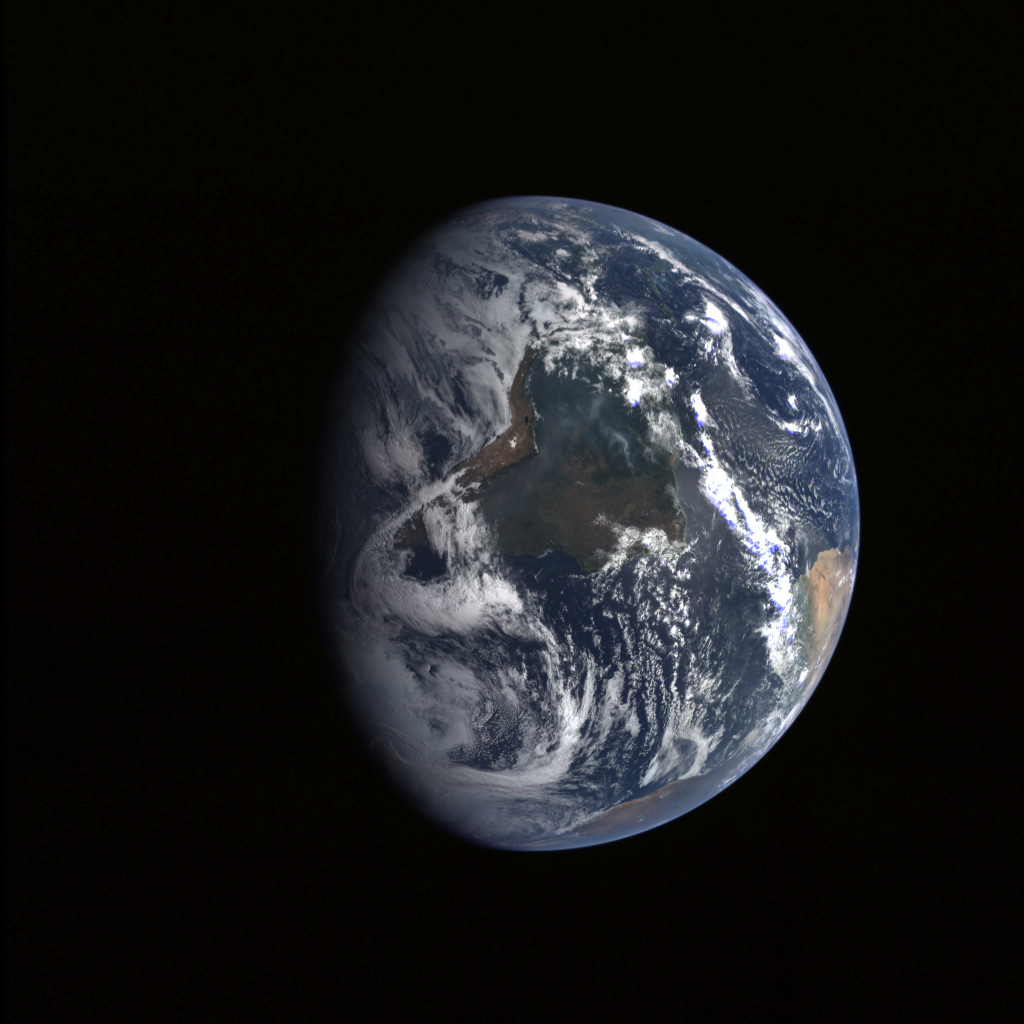
Because Mercury is so close to the Sun, getting a spacecraft into orbit around the planet poses special challenges—and unusually high amounts of fuel to control the spacecraft’s trajectory. MESSENGER’s flight path includes multiple planetary flybys, which use the planets’ gravity to adjust the spacecraft’s trajectory without fuel. Messenger completed its flyby of Earth on August 2, 2005. In exchange for the gravity assist Earth provided, MESSENGER sent back a picture postcard of our home planet. South America sits in the center of the globe, tilted to the right.
MESSENGER is the first orbital mission to Mercury; previous observations were only collected by flybys during the Mariner 10 mission. Why Mercury? describes the science objectives of the MESSENGER mission. The MESSENGER Gallery provides additional images and animations.
NASA images courtesy Science Operations Center at the Johns Hopkins University Applied Physics Laboratory. Caption by Rebecca Lindsey.